
Losing your shoreline to erosion is quite literally losing your property. And we’re not talking about the erosion that makes rock formations and takes thousands and thousands of years to happen. You can observe this erosion in real time. Unprotected, your shoreline is friable, vulnerable, and won’t take long to slip seaward. In this article we’d like to highlight a couple of Lake Winneconne property owners who are taking great strides to hang onto their shoreline.
Lakeshore property owners play a key part in reducing shoreline erosion and runoff. Shoreline erosion and runoff contributes to the total suspended solid load in the lake. You can read about how suspended solids diminish water quality here.
Work on Winneconne: The Stabenows

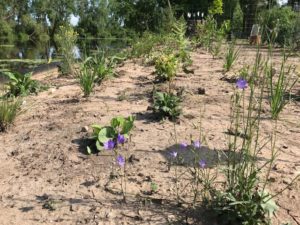
Valerie and Allen Stabenow are two Lake Winneconne residents that are doing an exceptional job improving their shoreline to reduce shoreline erosion and capture runoff. The Stabenows own an ~7.5 acre peninsula in the southwest corner of Lake Winneconne. What was a brush ridden peninsula with impaired and crumbling shoreline is now in a process of strategic transformation. The Stabenows have been clearing invasive brush such as buckthorn and honeysuckle, and planting native plants like cup plant and swamp milkweed. Improving plant diversity will better anchor fragile soils because different species will have different rooting depths, holding down the entire strata of soil. One side of their property borders a channel. On this side they planted a garden that includes native grasses and forbs as well as some ornamentals. Prairie Nursery and Stone Silo put together the plant lists and supplied their transplants.
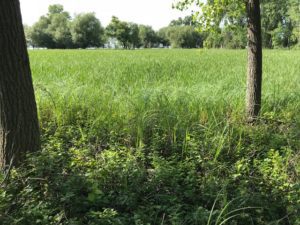
Stabenow’s wetlands. Native grasses and sedges face encroachment by Reed Canary Grass
The Stabenow’s property also includes about 4 acres of wetland. During my visit I observed native sedges and grasses in the wetland, along with forbs like blue vervain and marsh skullcap. Wetlands are one of the most important landscape components that work to improve Lake Winneconne’s water quality. Wetlands serve an important ecological function by acting as a filter to remove sediment, pollutants, and nutrients from water before it makes its way into the lake.
Effective Partnerships
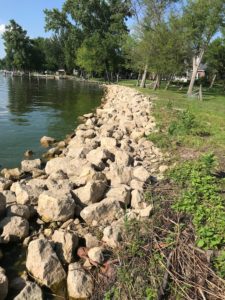 The other side of their property is along Lake Winneconne. Here they worked with Chad Casper of Winnebago County’s Land and Water Conservation Department. They contracted Johnston Pile Driving to place 313 tons of stone along 320 feet of shoreline. This stone will divert and absorb wave energy that would otherwise erode the shoreline. The Stabenows and Chad are designing a second installation that will include a breakwall in their bay. This breakwall will also absorb and divert wave energy before it hits shore, creating a protected area for aquatic vegetation to grow.
Interested in starting a similar project?
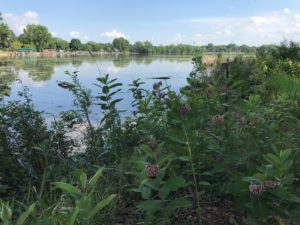
Blooming milkweed and other native plants on the peninsula
The multifaceted nature of a Lake Management Plan that is being developed for the Winnebago Lakes will improve water quality by engaging a broad spectrum of watershed residents. It will recommend priority projects to reduce runoff and erosion on the agricultural uplands and scale down to reduce the same thing along the lake shores.
While the lake management plan is still being developed, there are many great existing resources for lakeshore property owners interested in property improvements. We recommend exploring UW-Extension Lakes website, the WI Healthy Lakes program, or contacting your county land and water conservation department.
Winnebago Waterways is a Fox-Wolf Watershed Alliance program. The Fox-Wolf Watershed Alliance is an independent nonprofit organization that identifies and advocates effective policies and actions that protect, restore, and sustain water resources in the Fox-Wolf River Basin.
Follow the Fox Wolf Watershed Alliance’s Winnebago Waterways Program on our Winnebago Waterways Facebook page or @WinnWaterways on Twitter! You can also sign-up for email updates at WinnebagoWaterways.org.
This article was written by Austin Pethan for the Winnebago Waterways Program. Questions or comments? Contact Austin at austin@fwwa.org or (920) 920-851-4295.
