Species Description
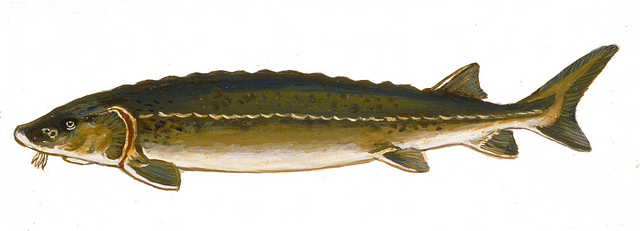
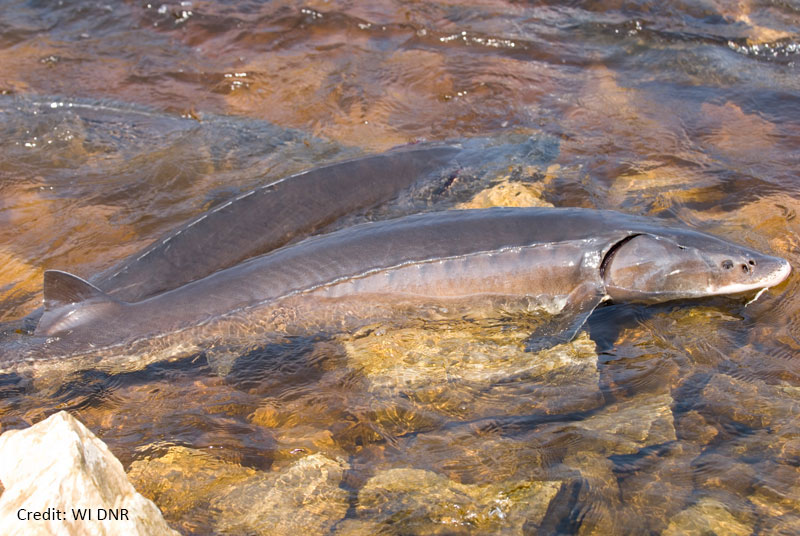
The lake sturgeon is a large, prehistoric, bottom feeding fish. Lake sturgeon have a rough, torpedo-like body that resembles a shark and can grow upwards of 7 ft. and 200 pounds. They have a heterocercal tail, meaning that the upper lobe is longer than the bottom lobe. Additionally, lake sturgeon do not have bones, rather, their skeletal support system is composed entirely of cartilage and they have a notochord that acts similar to a spinal cord in a human.
Identifying Traits
The color of a Sturgeon varies by waterbody, life stage, and fish to fish. The body is generally a shade of grey with a white underside. Bony plates called “scutes” run in five rows along the sides of the fish and make the fish appear to have armor. Finally, sturgeon have four barbels that look like whiskers, giving lake sturgeon an unmistakable look.

Credit: WI DNR
Life History
Lake sturgeon grow fairly quick during the earlier years of life, growing to approximately 3ft in 10 years. As lake sturgeon age, the rate of growth begins to slow. Sturgeon reach sexual maturity at 15-20 years of age for males and 20-30 years for females. Life expectancy is greater than 100 years!
Species Diet
Lake sturgeon traditionally feed on aquatic insects, leeches, snails, dead or dying fish and the occasional crayfish. In the Winnebago System, lake sturgeon predominantly feed on Chironomid (lake fly) larvae or gizzard shad.

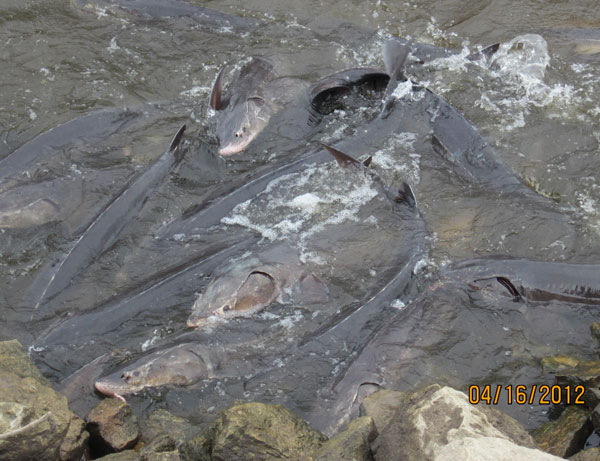
Sturgeon spawning on the Wolf River, Wisconsin
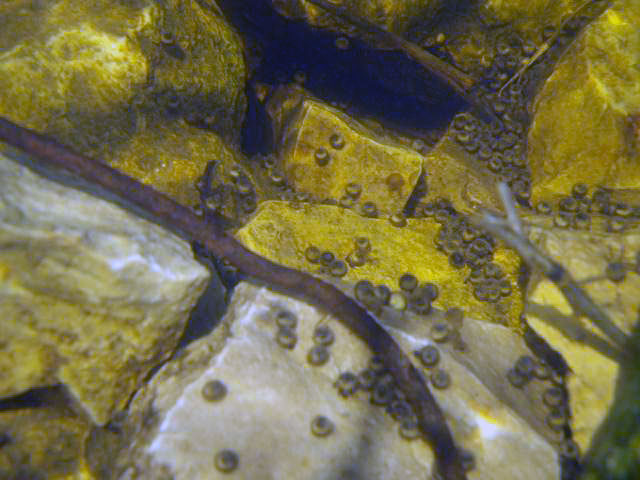
Sturgeon eggs on rocks.
Habitat Needs
Lake sturgeon constantly move throughout the Winnebago System at the bottom of the water column. During the spawning season lake sturgeon migrate up rivers to spawn. Spawning needs of Lake Sturgeon include adequate flow rates and substrate size (large riprap). The time of spawning is dictated by water temperature with fish spawning when water temperatures reach 52-60 degrees (F).
Species Range
Lake sturgeon are native to the Great Lakes, Hudson Bay, and Mississippi River drainage basins. Within Wisconsin, lake sturgeon are found in the largest river systems. The Winnebago System is home to one of the strongest populations of lake sturgeon in the world, and are found throughout the system, both in Lakes and rivers.

Sturgeon spawning. Photo credit: WI DNR

Fun Facts
Lake sturgeon are culturally important to the various Native American tribes throughout Wisconsin. In fact, the lake sturgeon is included in the creation story for the Menominee Indian tribe of Wisconsin. Lake sturgeon also exhibit sexual dimorphic growth, meaning that the females reach much larger sizes than males. Males max out at roughly 72 inches in length, while females have been observed at lengths greater than 85 inches.
What makes this species unique?
Not only are lake sturgeon the largest and longest living fish in the Great Lakes drainage, but many of the lake sturgeon’s features change throughout its lifetime based on age. As Sturgeon age, their ‘scutes’ become less pronounced the snout becomes more rounded and blunt, and the body color becomes darker.
Status/Management in the Winnebago System
The Winnebago System population provides one of the largest recreational harvest of the species through an annual winter spear fishery. The spear fishery is very closely regulated and the Winnebago System is one of only two places where sturgeon can be legally harvested with a spear.

Photo credit: WI DNR
Species Spotlight Author: Mason McGrath
Citations:
Lake Sturgeon. (n.d.). Retrieved from https://www.nwf.org/Educational-Resources/Wildlife-Guide/Fish/Lake-Sturgeon
Lake Sturgeon – Habits. (n.d.). Retrieved from https://dnr.wi.gov/topic/fishing/sturgeon/LakesturgeonHabits.html
Lake Sturgeon – Identification. (n.d.). Retrieved from https://dnr.wi.gov/topic/fishing/sturgeon/LakesturgeonIdentification.html
Lake Sturgeon – Life Cycle. (n.d.). Retrieved from https://dnr.wi.gov/topic/fishing/sturgeon/LakesturgeonLifeCycle.html