Fish Caught Off of Bowen St. Fishing Pier in Oshkosh
Updated 11/12/25: DNR will not be pursuing any sort of control or removal efforts towards eradication at this time. It is their position that the localized population of goby at the Bowen St. fishing pier and the Mill Street boat launch is too large an area for eradication treatment. There is no evidence of goby elsewhere in the Winnebago System. DNR states that competition with benthic forage fish, predation by larger fish, and other factors will impact when/if goby are able to widely disperse from the current localized population area around the fishing pier and boat launch.
Updated 10/8/25: Additional round goby have been caught at the Mill Street Boat Launch (roughly 0.1 miles from the original goby findings at Bowen St. fishing pier). Gobies caught in the area at Mill St. boat launch and the Bowen St. fishing pier vary in size and abundance.
Update 9/29/25: The September 25th, 2025 Round Goby Blitz had a total of 26 anglers across multiple sites deemed to be prime habitat for goby from Oshkosh to Neenah/Menasha to High Cliff State Park. The only site where goby were captured was the Bowen street fishing pier in Oshkosh (where all goby reports in the System have originated to date). Gobies were readily captured at this location, with 3 anglers totaling 35 goby caught. The WI DNR is currently assessing control/mitigation measures while continuing monitoring around the System.
In June, an angler caught a round goby in Lake Winnebago at the Bowen Street Fishing Pier in Oshkosh, the first known detection there. The invasive fish is about 3 to 6 inches long with bulging frog-like eyes and a fused fin on their bottom side that looks like a suction cup. They can outcompete bottom-dwelling fish and they’ve been known to gobble up eggs of walleye and bass.
Round gobies are native to the Black and Caspian Seas between Europe and Asia, and it’s believed they were first introduced to the United States through the ballast water of oceangoing ships in 1990. They have since spread to the Great Lakes and connecting waterways like the lower Fox River.
Monitoring has been increasing since that time to gauge the extent of the invasion. Was it only a single fish? Multiple? Are the fish in areas beyond the Bowen St. fishing pier? After the initial discovery, DNR staff conducted trapping and monitoring, but no additional fish were caught in Lake Winnebago. However, another angler reported catching the invasive fish in August, and around a few dozen round gobies have been caught to date.
Angelo Cozzola, a DNR fisheries biologist, said the fish can rapidly expand once they invade.
“That being said, since we are only finding them in one area right now, we are considering efforts for potential control,” Cozzola said.
The DNR and local fishing groups organized volunteers to help catch fish Thursday September 25th, 2025 on the Winnebago System in Oshkosh, Neenah, Menasha and High Cliff State Park near Sherwood.
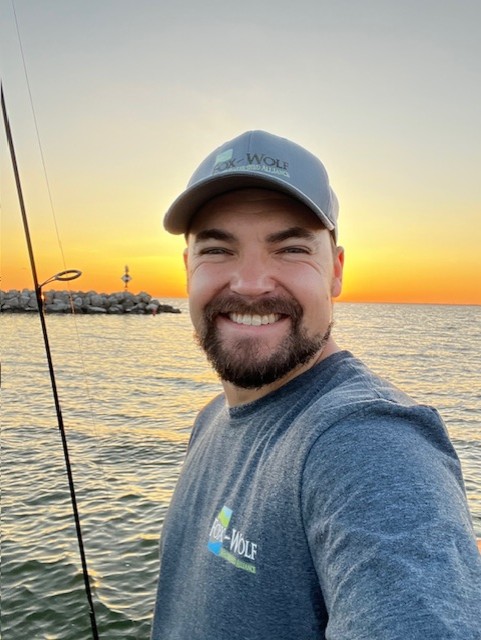 The Fox-Wolf Watershed Alliance is among those partnering with the DNR, including Chris Acy, the group’s aquatic invasive species coordinator. Acy said the “round goby blitz” is an effort to get more lines in the water to determine how widespread the fish is and what type of management may be needed.
“In some lakes that have them, they’ve seen bass populations be impacted,” Acy said. “They can be a nuisance for shoreline anglers. In places where they get really numerous along shoreline areas, people that are going out to fish for their favorite panfish are having less success…and more often than not, are catching gobies.”
If established, the fish could significantly impact sportfishing. Acy noted recreational fishing has a $234 million impact annually on the local economy, according to a 2006 survey by the University of Wisconsin-Extension. But it’s not just sportfishing being impacted in our region. Round goby were discovered in Little Lake Butte des Morts in 2015 and the Menasha Lock has been closed since that time. An 2017 study estimated that there is an economic output of $4.3 million – $29 million annually depending on lock openings, including the Menasha lock.
The DNR may consider other efforts to control the spread of round gobies, including the use of the chemical fish-killing agent rotenone. Cozzola said use of chemical treatment will depend on how far the fish has spread within the system. If round gobies are more widespread, chemical intervention would be less effective than treatment in a small, confined area.
In the meantime, the DNR is asking the public to report any sightings of round gobies within the Winnebago System, said Patrick Siwula, the agency’s aquatic invasive species biologist for southeastern Wisconsin.
“We’re talking about Lake Winnebago proper right now. But this system is huge and encompasses 17 percent of the state’s surface water drainage area,” Siwula said. “We’re talking about all the way up the Wolf River, the upper Fox River, the Winnebago pool lakes. Those are all areas we’re interested in receiving reports because 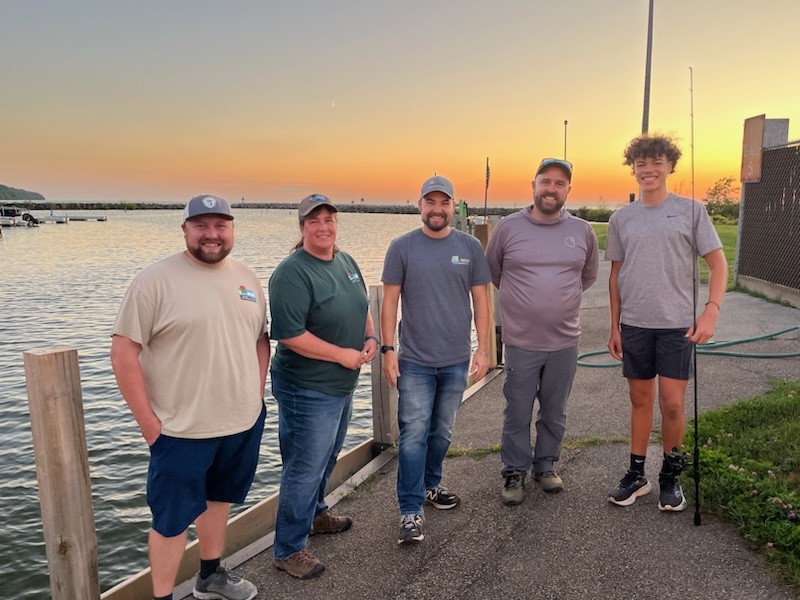 they’re connected waters.”
The DNR said the agency doesn’t need reports of round gobies captured below the Neenah or Menasha dams or in Little Lake Butte des Morts because it’s not part of the Winnebago System and the invasive fish is already well-established there. Cozzola said the DNR will continue monitoring for round gobies in the system.
“Once they’re established and they’re reproducing and spreading, there is nothing that we can practically do to take them out of the system,” Cozzola said.
If anglers catch a round goby, the DNR advises them to kill it and take it to a DNR service center. People can also report any invasive fish they observe using the agency’s online reporting tool.
Original Story: Wisconsin Public Radio, Danielle Kaeding
Photo Credit: Paul Skawinski, Chris Acy, Patrick Siwula
Questions? Comments? Contact Chris Acy, the AIS Coordinator covering Brown, Outagamie, Fond du Lac, Calumet, and Winnebago Counties at (920) 460-3674 or chris@fwwa.org!
Follow the Fox Wolf Watershed Alliance on our Fox-Wolf Watershed Alliance Facebook page or @fox_wolf_watershed_alliance on Instagram! You can also sign-up for email updates at fwwa.org.
The Fox-Wolf Watershed Alliance is an independent nonprofit organization that identifies and advocates effective policies and actions that protect, restore, and sustain water resources in the Fox-Wolf River Basin.
Reporting invasive species is a first step in containing their spread. Maintaining and restoring our waters and landscapes can reduce the impacts even when we don’t have other management options to an invasive species.
