
Pauline McCleary has been caring for water her whole life, long before she was raising beetles in the kiddie pools in her backyard. Raised on a farm with a spring-fed well, she learned early that water wasn’t just something that came from a tap. “If it goes in the lake, you’ll drink it later,” she says, a simple truth that still shapes how she shows up for her local watershed.
Now, in a quiet corner of her garden, five pots of purple loosestrife sit wrapped in netting, tucked into what her kids jokingly call the “death plant” cage. It’s not much to look at, just a tomato cage and some mesh, but this backyard setup plays a role in restoring local wetlands. It’s a nursery for Galerucella beetles, tiny insects that feed on the invasive loosestrife and help bring balance back to struggling ecosystems.
Pauline laughs when she explains her part. “I keep water in the pool. I keep the cage from blowing over. I babysit beetles, basically.” She also admits she’s afraid of bugs. “The netting helps. It’s almost like going to the zoo.”
Still, she calls it her “bravery test.” The beetles lay eggs on the loosestrife leaves, and when the larvae hatch, they chew the plants to tatters, halting their spread. “It’s satisfying to see the leaves all eaten up. That’s the goal!”
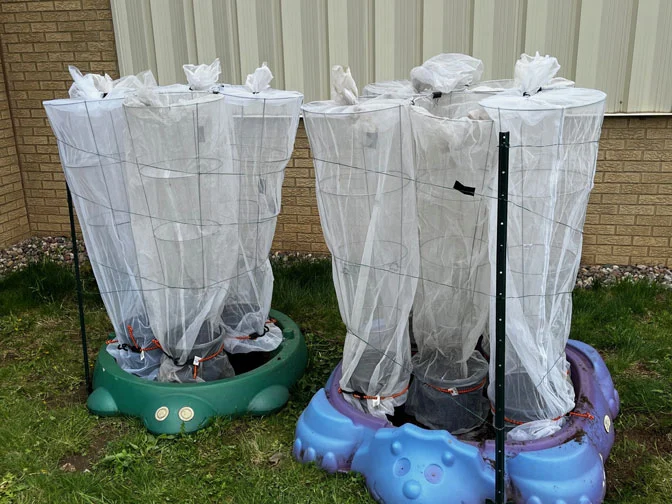
Purple loosestrife may look pretty, but it wreaks havoc across the Fox–Wolf Watershed. It crowds out native plants, clogs drainage ditches, and weakens the natural ability of wetlands to filter runoff before it reaches rivers and lakes. Hand-pulling and herbicides often fall short. The Galerucella beetles, raised in backyard nurseries like Pauline’s, offer a hyper-targeted solution that leaves native species untouched.
Pauline first came across the beetle program at a fire department open house. She struck up a conversation with “Beetle Guy Chris” Acy, Fox-Wolf’s Aquatic Invasive Species Coordinator. “He had this display, and I thought, huh… maybe this is something I can do.” Years later, she’s still helping raise beetles and sometimes hands over just one bag, “because that’s what I could handle this year.”
“It’s the butterfly effect. You do your part, it ripples out.”
Her quiet commitment extends beyond the pool. She brings trash bags on hikes with her German shorthair pointer. Her yard is filled with flowers chosen to feed bees and butterflies from spring through fall. “It’s all connected,” she says. “Even if you just clean up a ditch or a trail, it helps.“
In our watershed facing big challenges like flooding, pollution, and invasive species, it’s easy to feel powerless. But Pauline’s story reminds us that meaningful change often begins with small, deliberate actions and even smaller beetles.
After weeks of care, they’re taken and released into affected wetlands where they can finish the job. What starts in Pauline’s backyard reaches ditches, shoreline, and streams. That small handoff becomes something bigger.
“It’s the butterfly effect,” she says. “You do your part. It ripples out.”
Watershed Moments is a quarterly publication from the Fox-Wolf Watershed Alliance, sharing true stories of people whose lives have been shaped by water—and the moments that sparked their care for it.
Read more Watershed Moments, or support this work with a donation.