
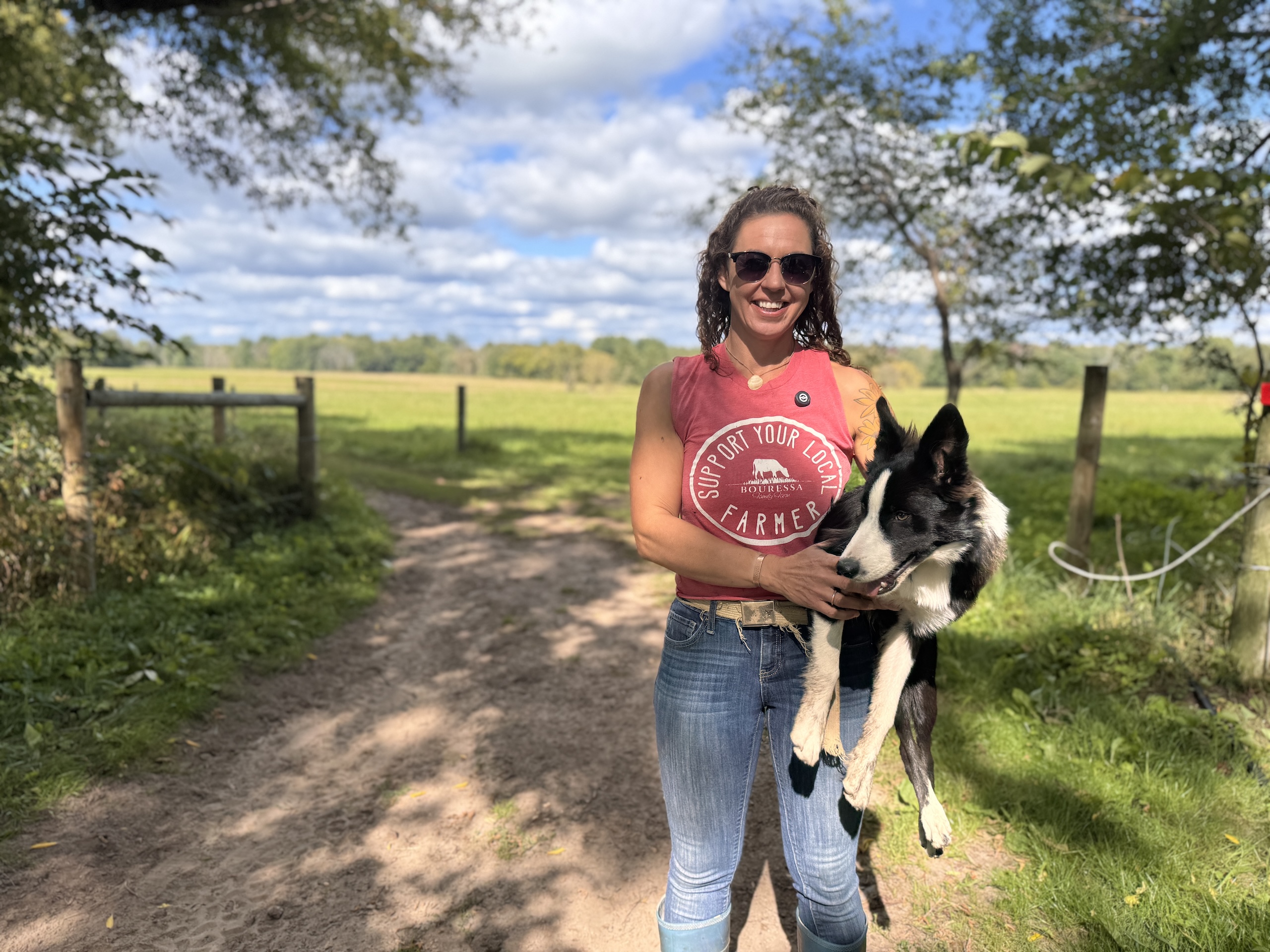
Rachel grew up chasing frogs in the low, wet corner of her family’s farm in Waupaca County. Her family called it “the swamp.” To Rachel, it was a place for tadpoles, muddy boots, and watching water that felt alive.
Her farm sits in the Fox-Wolf watershed, where rain and snowmelt eventually flow into the Wolf River, then into the Fox River, and out to the Bay of Green Bay. Even before she knew the word “watershed,” she was learning that water collects, moves, and carries life with it.
“The water had this dull, unhealthy look,” she says. “I did not want my kids anywhere near it.”

Her neighbors rely on private wells, and rising nitrate levels had become a real concern. Nitrates are a form of nitrogen that can move from farm fields into groundwater. At high levels, they can make drinking water unsafe, especially for babies and pregnant people.
“it’s for my neighbors’ drinking water”
Standing there, telling her kids no at the edge of a place she had loved as a child, Rachel realized something had changed. This was no longer just “the swamp.” It was her responsibility.
Today, she manages that ground herself as part of a beef and grazing operation. Instead of row crops, it is permanent pasture in a rotational system.
“I always say I farm from a soil first perspective,” she explains. Put simply, she keeps the soil covered in living plants and moves her cows often so grass can rest and roots can deepen.

On fields with bare soil, heavy rain can wash fertilizer and manure into ditches and, eventually, into rivers and the Bay of Green Bay. By keeping her fields in deep rooted grass, Rachel slows that water down so more of it soaks in cleanly and more nutrients stay where they belong, in the pasture. “Perennial grass is not just for my cows,” she says. “It’s for my neighbors’ drinking water.”
Over time, the old swamp has started to look different again. Ruts have softened. Grasses and clover have thickened. Frogs and birds have returned.
“I see the turkeys, the cranes, the indigo buntings, the bluebirds,” Rachel says, “and I think, this is what this land is meant to be.”
Her kids still seek out wet places. Across the road, they have named another pocket of standing water “Frog City,” a place for boots, frog calls, and the same kind of close-up water watching Rachel remembers from her own childhood.
Rachel knows her farm is one small corner of the Fox-Wolf watershed. Through farmer networks supported by groups like the Fox-Wolf Watershed Alliance, she trades ideas with others who also want to keep soil on their fields and pollution out of local water. After a storm, she walks back to that recovering basin and listens. Clear, shallow water settles among the grasses, holds the sky for a while, then begins its slow trip toward the Wolf River, down the Fox River, and out to the larger waters that connect her farm to the rest of us.
WATCH: Rachel’s Watershed Impact Award
In 2025, Rachel was honored with a Fox-Wolf Watershed Impact Award for her work and dedication to strengthen water quality throughout the watershed.
Watershed Moments is a quarterly publication from the Fox-Wolf Watershed Alliance, sharing true stories of people whose lives have been shaped by water—and the moments that sparked their care for it.
Read more Watershed Moments, or support this work with a donation.