
Boaters Who Know the ‘Stop Aquatic Hitchhikers!’ Rules Are Doing Their Part to Stop Invasive Species
Original Story: University of WI Sea Grant
Millions of dollars are spent each year on programs that encourage recreational boaters to help stop the spread of aquatic invasive species like zebra mussels and hydrilla. But do these programs, like the national Stop Aquatic Hitchhikers! and Clean Drain Dry brands, actually work?
Recently published research from a University of Wisconsin–Madison team shows — for the first time — that yes, they do.
“Before now, we only assumed these messages work,” said Tim Campbell, Wisconsin Sea Grant’s aquatic invasive species outreach specialist and coauthor of the study. “This research shows, for sure, that Stop Aquatic Hitchhikers! and Clean Drain Dry outreach help keep our lakes and rivers free of invasive species.”
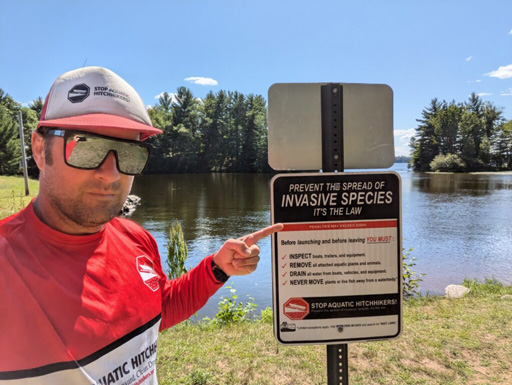
Tim Campbell points to a common sight at boat launches: a Stop Aquatic Hitchhikers! sign informing people about AIS. Photo by Tim Campbell / ASC
Campbell and coauthors Todd Newman of the UW–Madison Department of Life Sciences Communication and Bret Shaw, UW–Madison Department of Life Sciences Communication and Division of Extension, worked with a national social science research firm to survey boaters about their actions related to invasive species prevention and their awareness of two invasive species prevention messages and brands, Stop Aquatic Hitchhikers! and Clean Drain Dry. The study found that boaters who were more aware of the brands reported that they removed plants from boats and drained water from live wells more often than people who were unaware of the programs.
Outreach materials from both brands are ready to use and available to anyone, often for free or at a nominal cost.
“What I like about this research is that it supports that there are some easy and effective things anyone can do, like using Stop Aquatic Hitchhikers! and Clean Drain Dry,” said Campbell. He added that, while important, brand awareness is one of many factors that determine if and when boaters take action to prevent the spread of invasive species.
“These brands and messages are the foundation of our outreach and prevention tools,” said Campbell. “People that are already using these approaches can then layer additional prevention approaches like inspectors and cleaning stations to further protect our lakes and rivers from invasive species.”
Questions? Comments? Contact Chris Acy, the AIS Coordinator covering Brown, Outagamie, Fond du Lac, Calumet, and Winnebago Counties at (920) 460-3674 or chris@fwwa.org!
Follow the Fox Wolf Watershed Alliance on our Fox-Wolf Watershed Alliance Facebook page or @fox_wolf_watershed_alliance on Instagram! You can also sign-up for email updates at fwwa.org.
The Fox-Wolf Watershed Alliance is an independent nonprofit organization that identifies and advocates effective policies and actions that protect, restore, and sustain water resources in the Fox-Wolf River Basin.
Reporting invasive species is a first step in containing their spread. Maintaining and restoring our waters and landscapes can reduce the impacts even when we don’t have other management options to an invasive species.
