
“Return to Pre-Pandemic Levels of Control”, Says Vice-Chair of Great Lakes Fishery Commission
Original Story: SooToday.com
The Great Lakes Fishery Commission (Commission) is pleased to announce that adult sea lamprey abundances declined in four of the five Great Lakes during 2026, reflecting continued progress in the binational effort to suppress populations of this destructive invasive species.
Adult abundance estimates decreased in Lakes Superior, Michigan, Huron, and Ontario, while Lake Erie experienced a slight increase. Based on three-year average abundance estimates from 2024 through 2026, sea lamprey populations in Lakes Erie and Ontario remained below established target levels, while populations in  Lakes Superior, Michigan, and Huron remained above their respective targets.
“Sea lamprey control remains one of the Great Lakes’ greatest fisheries management success stories,” said Earl Provost, chair of the Commission.
“This year’s results demonstrate that continued investment in control is reducing sea lamprey abundance and protecting fish populations across the basin. These achievements are made possible by the dedication, professionalism, and expertise of the staff—particularly partners at the U.S. Fish and Wildlife Service and Fisheries and Oceans Canada—who work together across the Canada-US border to carry out this critical work.”
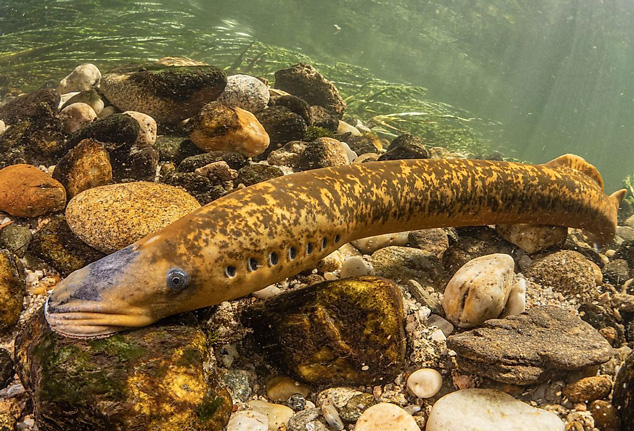
Sea lampreys are invasive parasitic fish that attack and kill a wide variety of Great Lakes fish species by feeding on their blood and body fluids. For more than 70 years, the Commission has led the binational effort among Canada and the United States to protect the Great Lakes from the destructive impacts of invasive sea lamprey. Sea lamprey control primarily consists of the use of lampricides and barriers, with trapping adult sea lamprey as a means to measure and track abundance. Additionally, the Commission is evaluating new and supplemental controls to further enhance sea lamprey control.
 “The pandemic created challenges that reverberated through the sea lamprey control program for years afterward,” said Ethan Baker, vice-chair of the Commission. “Because sea lampreys spend several years in streams before reaching adulthood, the effects of missed treatments are not immediately reversed. The good news is that we’ve returned to pre-pandemic levels of control, and the declining abundance we’re seeing in most of the lakes gives us confidence that the program is once again producing the results Great Lakes fisheries depend on.”
In 2026, control agents assessed 27 of the 29 streams used to generate adult sea lamprey abundance estimates throughout the Great Lakes basin. Mark-recapture assessments provided abundance estimates for most streams, while statistical models were used in a small number of cases where field conditions limited data collection. A total of 29,206 adult sea lampreys were captured at index sites basin-wide during 2026. No significant five-year trends were detected in any of the Great Lakes, underscoring the importance of continued monitoring and sustained control efforts.
LAKE SUPERIOR: The 2026 adult sea lamprey index for Lake Superior was estimated at 29,767, a decline from 40,610 in 2025 and less than half the abundance observed in 2023. Despite the decline, the lake’s three-year average abundance estimate of 41,976 remained substantially above the management target of 10,421. Biologists completed assessments at all seven index streams. The Bad and Tahquamenon rivers accounted for the largest portions of the lake-wide abundance estimate.
LAKE MICHIGAN: Lake Michigan’s adult sea lamprey index was estimated at 20,211 in 2026, slightly lower than the 2025 estimate of 21,273 and near the target abundance level of 20,526. The lake’s three-year average estimate was 22,094. Adult abundance in Lake Michigan has remained relatively stable and near target levels for much of the past decade. Estimates were generated from six index streams, with most based on mark-recapture assessments and others supplemented through modeling approaches.
LAKE HURON: The adult sea lamprey index for Lake Huron declined to 29,602 in 2026, down from 44,591 in 2025 and nearly 50% lower than the peak observed in 2022. The lake’s three-year average abundance estimate was 38,026, which remains above the target level of 31,274. All six Lake Huron index streams were successfully assessed. The Cheboygan River contributed the largest share of the overall estimate.
LAKE ERIE: Lake Erie’s adult sea lamprey index increased modestly to 923 in 2026 from 803 in 2025. Despite the increase, the lake’s three-year average abundance estimate of 865 remained well below the target level of 3,263. Current abundance levels represent a significant decline from recent highs and continue to reflect strong suppression of sea lamprey populations in Lake Erie.
LAKE ONTARIO: Lake Ontario’s adult sea lamprey index declined to 7,281 in 2026 from 11,584 in 2025. The lake’s three-year average abundance estimate was 13,747, slightly below the target level of 14,065. The decline continues a downward trend from the elevated abundance observed several years ago. The Black and Humber rivers accounted for much of the adult sea lamprey abundance measured in the lake’s index streams.
But don’t forget that hear in Northeast Wisconsin, we have native lamprey in addition to the invasive sea lamprey. Read more on how to tell the difference between invasive vs native lamprey here.
Photo Credit: T. Lawrence (NOAA), Manuel Garcia,
Questions? Comments? Contact Chris Acy, the AIS Coordinator covering Brown, Outagamie, Fond du Lac, Calumet, and Winnebago Counties at (920) 460-3674 or chris@fwwa.org!
Follow the Fox Wolf Watershed Alliance on our Fox-Wolf Watershed Alliance Facebook page or @fox_wolf_watershed_alliance on Instagram! You can also sign-up for email updates at fwwa.org.
The Fox-Wolf Watershed Alliance is an independent nonprofit organization that identifies and advocates effective policies and actions that protect, restore, and sustain water resources in the Fox-Wolf River Basin.
Reporting invasive species is a first step in containing their spread. Maintaining and restoring our waters and landscapes can reduce the impacts even when we don’t have other management options to an invasive species.
